The Fool
Some years ago, an ex-boyfriend found my Tarot cards on my bookshelf. Like most people, he had only really seen the Tarot in movies and was curious about them. I told him to think of a question and shuffle them, then pull out a card, and I'd tell him what it might mean. He dutifully shuffled the cards.
I asked him what his question was.
He asked: "Who am I?"
The card he pulled in answer to his question was The Fool.
The Fool is a card that can have many different meanings, but in this case, I think my deck may have been right on the money. In the most banal, straightforward way. He was a fool. In all likelihood, he still is. Unfortunately, I had not yet realized this at the time. He has probably not realized this even today.
Sometimes, the Tarot can feel like an inside joke, and it feels good when you're in on it, but most of the time, the answer is a little more complex, a little less direct, a whole lot more layered or confusing.
The Fool in particular, is one such card. THE card, perhaps. It throws a curveball into an otherwise clear reading.
The Fool is not really a fool in the modern sense. In the earliest surviving Tarot decks, the Fool is depicted as a beggar or vagabond, not a jester. In the Visconti-Sforza deck (15th-century Italy), he wears ragged clothes and stockings without shoes, a patched shirt and loose feathers in his wild hair. There is a club or staff in his hand, but no little package.
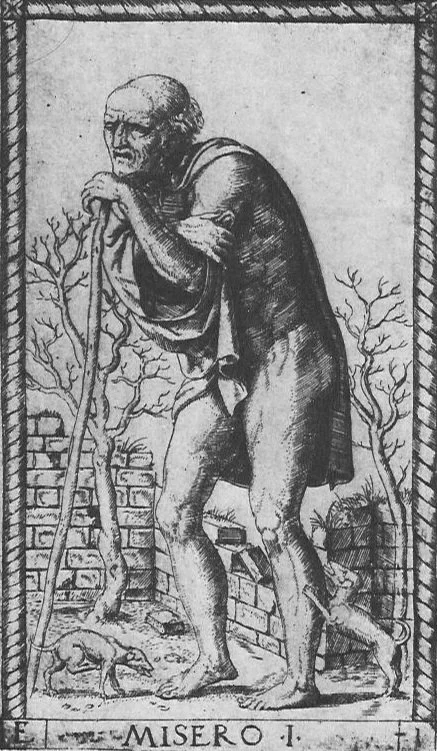
The so-called Mantegna Tarocchi (c. 1470s) takes it one step further and depicts an old naked man leaning on a staff, with two dogs lapping at him. He stands by a crumbling house wall, and the label beneath reads "Misero."
In a few other decks, many of these images are combined, increasingly featuring elements of the jester, such as colourful clothes or a hat with bells. In some decks, his genitals are hanging out in the breeze.
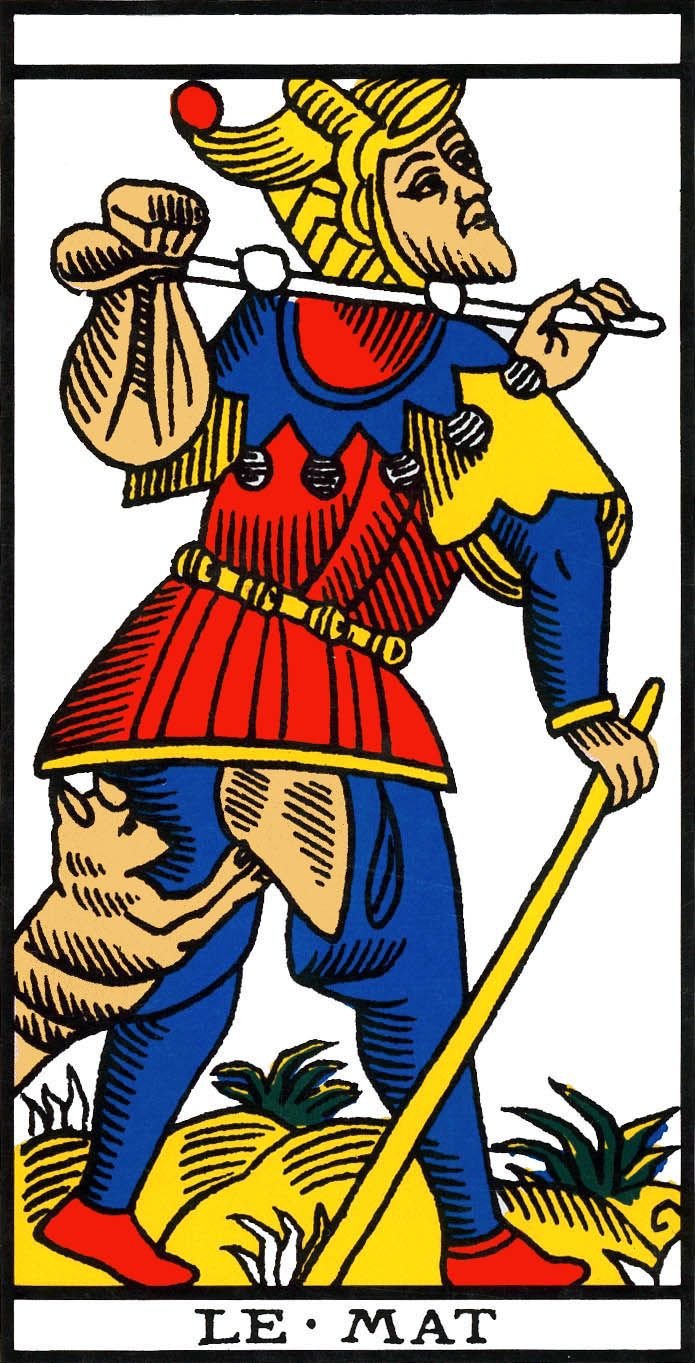
The Fool is titled Le Mat in the Tarot de Marseille and Il Matto in Italian decks — both meaning "the madman," not quite the way we think of fools.
There is a power in the madman, those people touched by the finger of God, and thus considered unimpeachable or even holy in many world cultures. In that sense, The Fool may have originally been closer to a different concept, one I’d think of as "the Idiot."
The word "idiot" certainly has some negative connotations in modern English, but the word has positive roots. Idiot derives from the Greek idios, which simply means a private
person, or, even more telling, an individual. More in keeping with the word "idiosyncratic" in its modern use.
The Fool is above all a unique individual, one who is willing to test their mettle, to take a step off the beaten path, whatever may come. There is a "...primitive, unshaped energy, where all things emerge and return. Associated with the numbers 0 or 22, our Fool is a sort of wild card, a dynamic tightrope walk through the symbolic tale of the trump cards."²
The journey is the Fool's journey, and we could almost see the other cards as permutations or expressions of the Fool's energy in different guises. The Fool can be interpreted as the start of a journey, starting from nothing. Perhaps this is why its number is 0. The beginning of something. Or the end. 22.
The Rider-Waite-Smith deck suggests beginning by labelling the card 0, though some decks give it the number 22, which would make it the end, suggesting an entirely different conclusion: that even after the journey, one still remains a fool. What's interesting here is that another great divination system, the I Ching, uses a similar logic. The last hexagram, number 64, is called "Before Completion," even though it is the end of the journey. The first hexagram, number 1, "The Creative", is for most intents and purposes the carrier of the same Fool energy. The beginning, the expression, the “breathing into life”. It is very much in keeping with how many interpret The Fool card: as a single idea, a thought, something that simply becomes and needs to be tested to arrive at a conclusion or validation.
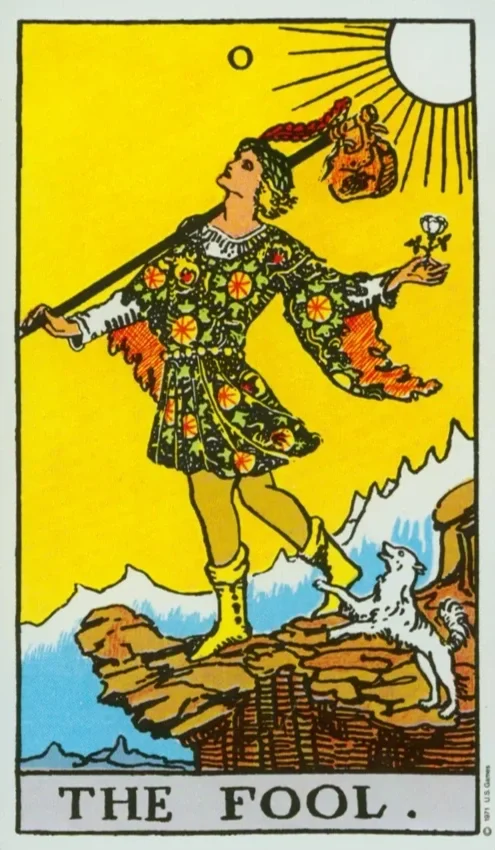
In the deck I use, the Rider-Waite-Smith deck (so many people leave out the "Smith," but Pamela Colman Smith was the illustrator of the cards), the Fool she envisioned is an androgynous figure who has shed the traditional jester's outfit and chosen a lovely tunic with a morning glory pattern and fiery sleeve edges. The Fool is portrayed as a young person about to take a misstep. There are cold, deep mountains ahead; the Fool stands at the cliff edge, and even though their canine companion is barking a warning, the young person ploughs ahead, a white rose — symbolic of innocence and purity — in their hand.
It is almost as if they, following the romance they themselves have devised, are about to learn a harsh lesson about life. Young, well-dressed, not a fool as much as an idealist. The sun is high in the sky, warm yellow light all around, but the bundle they carry and the clothes they wear look too small and fine for the journey through the mountains.
The Smith deck also kept the image of the guardian dog barking at the Fool’s heels. "Danger, danger" or "This calf looks tasty"? You decide.
The dog motif seems to derive from the Tarot de Marseille, but it is not a consistent representation. Some decks show the dog as a friend, others as a menace. In Oswald Wirth's 1889 Tarot des Imagiers du Moyen Âge, "Le Fou" draws a pained expression as a rabid cat bites his calf, his ripped trousers revealing his bare bottom, while an opportunistic crocodile lies in wait for the Fool's misstep and a tasty meal. Crocodile? I know — weird. But at the time, there was a widespread belief that the Tarot originated in Egypt, and a crocodile seems fitting, what with the Nile and all that.
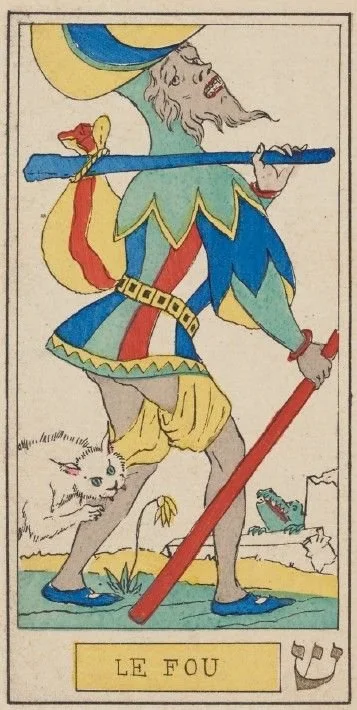
Can you see the crocodile? It’s right below this text-box, in the bottom right corner. Its little hands really make me smile!
So how does this all add up in interpretation? If you receive this card as your conclusion, you could see it as a kind of "FAFO" or just an "I dunno". A shrug, the answer undecided. It may refer to a journey being taken, the start of something new, a warning that you're setting off down a dangerous path, or simply an unknown one. There are many other interpretations, as many as there are questions. A beginning, a warning, or simply a reminder that we are inconveniently as unpredictable to ourselves as anyone else. This particular card leaves a lot open. Most of the Major Arcana cards are elusive; the Minor Arcana a little less so — but this one is notoriously tricky. And sometimes, it can just be a well-placed joke. That guy you're dating? He may just be a fool.
Notes
¹ Byung-Chul Han, Psychopolitics: Neoliberalism and New Technologies of Power, translated by Erik Butler (Verso, 2017), Chapter 13: "Idiotism," p. 81.
² Laetitia Barbier, Tarot and Divination Cards: A Visual Archive (Laurence King, 2021), p. 31.
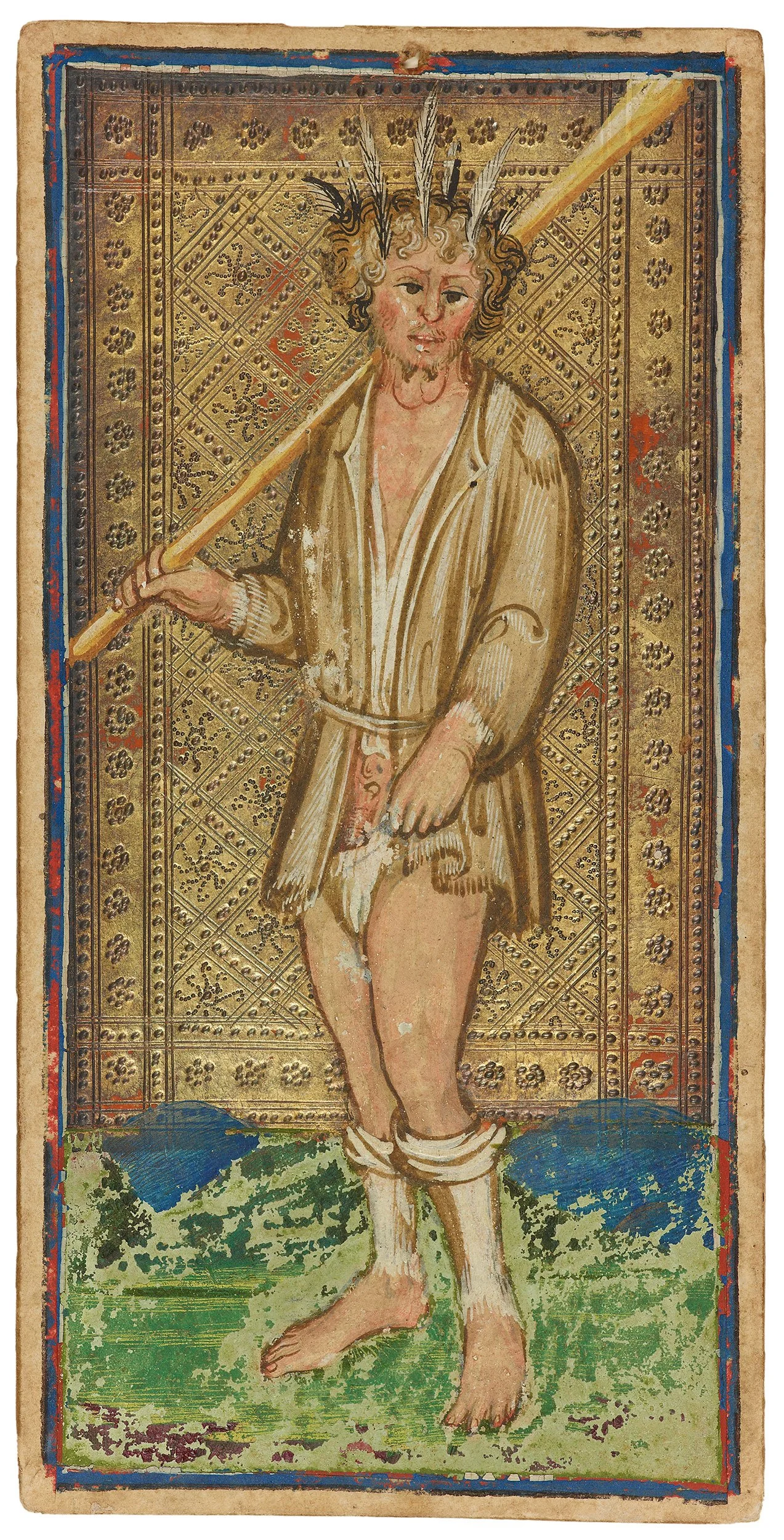
The Visconti-Sforza Fool, a beggar in ragged clothing, perhaps a madman (just look at the feathers in his hair!)